

b2If you are in sales you are well aware of weekly sales review meetings and, the numbers countdown begins every week of every month at your week. The painful but real aspect of sales just never changes. It essentially boils down to two things: numbers and time.
These two things often go hand-in-hand. While we are racing to hit quota against that clock. We can save time and maximize our numbers by investing in the right processes, activities, and skills.
Truth is, sales are changing — quickly. As sales conversations grow even more buyer-focused, sales reps have begun developing their hacks, techniques, and processes for prospecting - SMarketing.
- What is Prospecting?
- Lead vs Prospect
- Sales Prospecting Techniques
- Guide to Prospecting
- Sales Prospecting Tools
And that’s where this guide comes in. In this growing sales landscape, we’ll outline the various processes and key strategies for prospecting — the phase of selling that often consumes the most time and energy... and is the most crucial to get right. So, let's start with a quick refresher.
What is prospecting?
Prospecting is the process of initiating and developing new business by searching for potential customers, clients, or buyers for your products or services. The goal of sales prospecting is to move these people, or prospects, through the sales funnel until they eventually convert into revenue-generating customers.
One of the most important aspects of effective prospecting is identifying good-fit customers for your business. This means finding leads and prospects who truly need your product or service to solve their challenges and pain points.
These are the people who provide you with long-term business and value versus those who churn after closing a deal. You can identify good-fit customers while prospecting by asking the right sales qualification questions to all of your leads and prospects.
Speaking of leads and prospects, it's important to note the differences between these two types of people that you and the rest of your sales team will be communicating with while prospecting.
Lead vs Prospect
Leads are potential customers who've expressed their interest in your company or services through various behaviors such as visiting our website, subscribing to a blog, or downloading an ebook. Leads become prospects if they are qualified and, therefore, align with your target audience and buyer personas.
You can have a prospect (not a lead) that can be classified as a potential customer even if they have limited or no interaction with your company depending on their qualifications and fit.
It's also important to remember that although leads and prospects differ by definition, your goals with both are the same: Nurture leads and prospects until they buy your product or service.
To get a better understanding of the sales prospecting process as a whole, look at the sales funnel:
1. Research
Goal: Determine the quality of the lead
Qualifying dimensions: A set of criteria to evaluate the probability that a lead or prospect will become a customer.
CRM (customer relationship management): Software that allows companies to keep track of their potential and existing customers at whichever stage they may assume in the sales cycle.
2. Prospect
Goal: Get to connect
Gatekeeper: A person in charge of communicating or preventing information from reaching a decision-maker; for example, receptionists or personal assistants.
Decision-maker: The person in charge of making a final decision on the sale. We usually have to go through a gatekeeper to reach them.
3. Connect
Goal: Schedule the next meeting
Discovery call: The first contact a sales rep makes with a prospect to qualify them as a lead for the next step in the sales cycle
4. Educate and Evaluate
Goal: Evaluate and qualify needs
Pain point: A prospect’s business need; this is what sales reps must identify to provide value and move them farther along in the sales cycle
Objection: A prospect’s challenge leading to opposing a product or service, i.e. budget, or time constraints.
5. Close
Goal: Turn Opportunities Into Customers
Closed-won: When the buyer purchases a product or service from the sales rep.
Closed-lost: When the buyer fails to purchase a product or service from the sales rep.
Closing ratio: Ratio of prospects that a sales rep closes and wins.
Sales Prospecting Techniques
As the sales environment matures, we’re seeing a shift from an either/or methodology of prospecting. Reps no longer have to choose between inbound or outbound prospecting. Instead, they must decide how to do both responsibly.
Here’s the big difference between the two methodologies:
OUTBOUND PROSPECTING VS INBOUND PROSPECTING
Outreach Cold calling — unsolicited calls to sell a product or service
Warm emails to explore a relationship with a leader who has already expressed familiarity with your product or service.
Social spamming
Unsolicited social media messages to sell a product or service
Using social media to explore a relationship with a leader who has already expressed familiarity with your product or service; sales reps can provide value to prospects on social media by answering their questions and introducing them to useful content
Process
Research takes longer without any prior history with a contactless context for us when we’re ready to reach out to establish a connection
The research process is shorter as we already have their contact information and interaction history — it provides us with context about the prospect’s interests or prior behavior, allowing us to develop more personalized outreach
Example:
“Hi Sam, I wanted to reach out to you because I’ve worked with companies similar to yours in the past."
Hi Sam, I’m reaching out because I noticed you were looking at our e-book on improving sales productivity.”
Recommendation: The Inbound Methodology
A responsible approach to outbound tactics like cold calling and cold outreach. Because let's face it — not every lead you get will be "warm". Our world is now characterized by infinite information, whenever we want.
Before we make a purchase decision, 60% of us rely on word-of-mouth, friends, and social media; 49% on customer references; 47% on analyst reports and recommendations; and 44% on media articles
Before a salesperson even has a chance to contact a prospect, he or she is already 57% of the way through the sales process. Yet, salespeople are still cold calling as if buyers have no awareness. Experienced salespeople can expect to spend 7.5 hours of cold calling to get one qualified appointment, according to a Baylor University study.
It’s time companies and sales reps start paying attention to buyers, leveraging their context, and understanding who they are and what they need.
Companies using inbound and responsible outbound sales techniques are better positioned for success in this new realm of buyer awareness. 64% of teams that use inbound selling reach their quotas as opposed to 49% of sales teams that use only outbound sales. IBM even increased its sales by 400% after implementing its inbound sales program.
Now, let’s look at specific frameworks and techniques for how we can adopt an inbound approach to prospecting.
A Guide to Prospecting
Sales professionals know that prospecting can be a time-consuming and unproductive aspect of their job. That's why we're here to offer a fresh perspective and help you avoid wasting your valuable time.
Our approach is based on the inbound methodology but with a unique twist. We understand that every salesperson has their style, so we've included personal tips and tricks from the top performers in the industry. Feel free to pick and choose what works best for you.
Step 1: Research
Qualifying prospects is crucial in the prospecting process. It allows us to determine if a prospect is a good fit and increases our chances of providing value to them or their business.
During this stage of prospecting, we have a few goals in mind:
1. Determine if the prospect is workable.
2. Qualify and prioritize prospects.
3. Find opportunities to build a connection through personalization, rapport building, and trust development.
To help evaluate the probability of a prospect becoming a customer, here are some qualifying questions and key takeaways:
1. Is the prospect's business an organizational fit?
This qualification is based on demographics. Does the prospect fall within our territory? Do we sell in their industry? Does it align with our buyer persona? By focusing on small to medium-sized businesses with 100 to 1,000 employees, we can eliminate potential customers outside of these criteria. Additionally, prioritizing customers based on the size of the opportunity or their potential lifetime value is essential.
2. Have you identified key stakeholders?
There are two types of people involved in the sales process: decision-makers and influencers. Influencers may not have the power to buy, but they can become strong advocates for our product. Identifying decision-makers and influencers and understanding the decision-making process is crucial. By keeping a list of influencers and buyers, we can use it later in the outreach phase of prospecting.
3. Are the prospect's constraints deal-breakers?
Time constraints and budget limitations are common objections from prospects. To avoid wasting time, it's important to do some homework beforehand and filter out potential buyers who may not have the bandwidth to consider our offering. Taking note of prospects with constraints and revisiting them at a later date can be beneficial.
4. Do you have familiarity with the market?
Prioritizing prospects in markets or industries we are familiar with is important. Our pitch and sales techniques are likely to be more refined in these areas. Grouping similar prospects based on characteristics such as their service offering, market, or industry and prioritizing these groups based on familiarity is recommended. Additionally, focusing on prospects to whom we can provide more value increases the likelihood of them buying our offering.
5. Do they have awareness of our offering?
Prospects will have varying levels of knowledge about our product or services. The more awareness they have, the more likely they are to see the value in our offering and become customers. Grouping prospects by their level of awareness allows us to leverage this familiarity in the sales process.
By following a sales qualification framework like the GPCTBA/C&I framework, we can effectively connect with potential customers and prioritize our efforts.
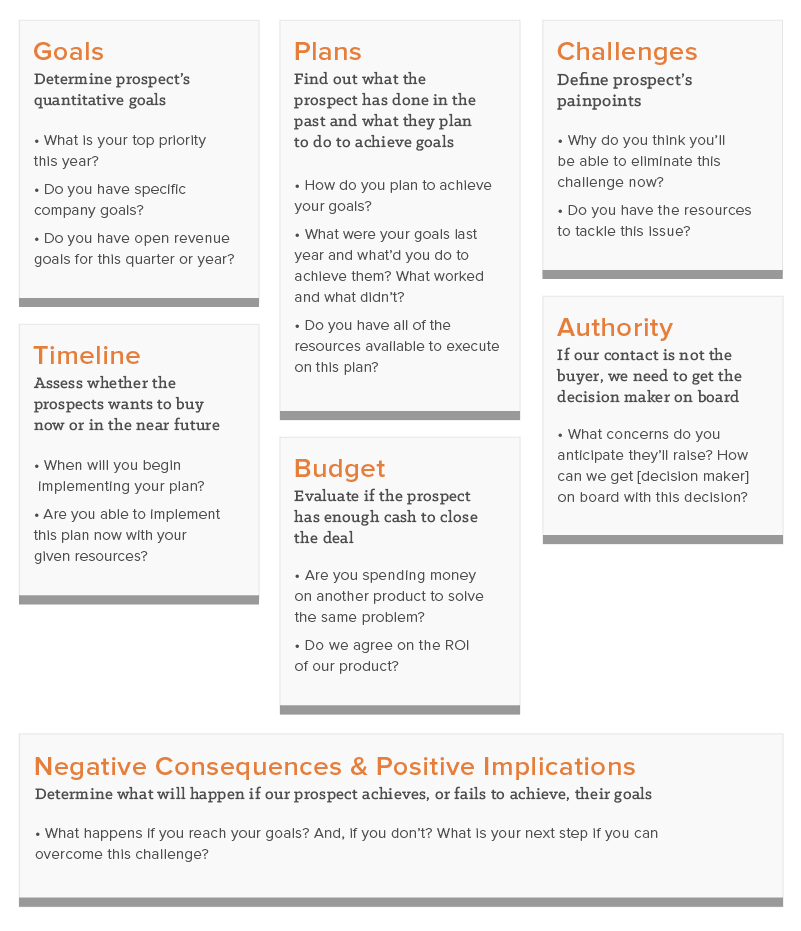
Now we can focus on creating a highly targeted, relevant list. Based on our research, we should have a fine-tuned profile of our target customer, and every company or individual on our prospect list should meet those criteria.
Step 2: Prioritize
Prioritizing our prospects can save us time and ensure we’re dedicating our strongest efforts to prospects that are most likely to become customers. Levels of prioritization will vary between each type of sales organization and each salesperson, but the main idea is to create a few buckets of prospects based on their likelihood to buy and focus on one bucket at a time.
Let’s break down the qualifying dimensions used in our list above (and any additional relevant dimensions) into percentages between 1% and 100% based on how important they are to the sales process. For example, the size of the opportunity is probably more important to us than timing in terms of closing a deal, so it would receive 70% whereas timing would receive 5%.
Now we can assign a value between 1 and 100 to these dimensions for each prospect in our list. Once we complete this step, we can multiply each prospect’s value by the percentage weight we gave to the dimension.
Add up these dimension scores until each prospect has a total score. And now our entire list is prioritized.
Lead management software does this automatically.
We can also qualitatively classify prospects by rating them on a spectrum from high, medium, and low as follows:

- Matches criteria for customer persona
- The clear business challenge that aligns with our product offering
- Able to connect with a decision-maker
- We have a mutual connection or common interest (i.e. mutual friend on LinkedIn or both graduated from the same college)
- High level of interaction with our website or social media accounts
- Recommended effort: Five touchpoints every other business day

- Match some elements of our customer persona
- A clear business challenge that aligns with our product offering
- Able to connect with an influencer
- Some level of interaction with our website or social media accounts
- Recommended effort: Five touchpoints every other day

- Don’t match with our customer persona
- Unclear business challenge
- Not able to connect with an influencer or decision-maker
- Limited or no interaction with our website or social media accounts
Recommended effort: Five touchpoints every other day
Step 3: Prep the Outreach
The end goal of this step is to gather in-depth information on our prospects to hone our pitch and personalize our outreach. So first, we must determine what our prospects care about.
We can do this in a few ways:
- Determine whether or not the prospect blogs to learn about what they're writing and publishing to see what they care about.
- Identify and review their social media profiles — do they have recent updates or new posts?
- Check the company website to review their “About Us” information.
Once we’ve learned more about our prospect’s business and role, we need to find a reason to connect. Do we have mutual connections? Has there been a trigger event? Have they recently visited our website? If so, which search terms drove them to our site? Which pages did they look at?
If we want to get more high-level with our prep, we can create a decision map to outline our prospect's options and end goals. This will help us better handle any objections and personalize a pitch that resonates with their primary objectives.
We could also conduct a competitive analysis to determine how we can better position our company's service or product within the industry and how we can combat prospects' objections.
Kyle Van Pelt reads 30 articles in 30 minutes every day and uses the content in his email outreach in a tailored, relevant way. And he achieved a 90% response rate.
Kyle uses Digg to subscribe to the company’s blogs he thinks would make for good prospects. Here’s how it works:
- Open each interesting post in a new tab.
- Skim each post.
- Read the most interesting posts.
- After skimming through all of the options, narrow the final list down to the most interesting posts. There will typically be between 20-30 posts left. We should put ourselves in the prospect’s shoes as we’re reading these articles, searching for pain points or trigger events.
- Use the most interesting, relevant information we find in the articles to tailor an email or a call to our prospect.
All of these questions will help us craft more context around our prospect’s situation which will help us when we’re ready to make that initial contact.
Create a list of top-priority prospects on Twitter to more easily track trigger events and streamline the research process. Here’s how to set it up:
- Click your profile picture next to the Tweet button in the upper right-hand corner of the page, and then click “Lists.”
- Now click “Create new list” on the sidebar.
- Name the list and then set it to “Private” so only you can access it.
- Now add the prospects you want to track to your list. Just search for their accounts, click the gear icon next to their profile picture, and then click “Add or remove from lists.”
Note: You may want to group your high-priority prospects in one list, followed by your medium-priority prospects and then low-priority. - Now that you’ve created the list, we can easily monitor our prospects’ activity using a tool like HubSpot Social Inbox. HubSpot’s Social Inbox color-codes your customers and leads and helps you prioritize your engagement. You can see what type of content resonates with your prospects by tracking their interactions, conversations, and new follows.
Watch as this feed populates with prospect activity. We can check this every morning and afternoon to see if any trigger events have occurred that would provide a valuable opportunity for us to connect.
Step 4: The First Touch
Whether calling or emailing, our outreach should be highly tailored to our prospect’s particular business, goal, or industry.
Keep these general tips in mind when contacting a prospect, whether on the phone or through email:
- Personalize. Reference a specific problem that the prospect is encountering with a specific solution.
- Stay relevant and timely. Ensure the issue a prospect is trying to solve is still relevant to him or her and their team.
- Be human. No one likes to communicate with a professional robot. Adding in details like wishing someone a happy holiday weekend or conveying how awesome their company’s product is are real touches that allow us to establish a connection on a deeper level.
- Help, don’t sell. Provide value and ask for nothing in return. This process isn’t about us, it’s about THEM. For example, instead of scheduling a follow-up meeting, we could offer to conduct an audit on their digital media presence and get back to them with our findings in a week.
- Keep it casual. Remember that this is just a conversation. Stay natural and as not salesy as possible. The key to prospecting is that we’re never selling. We’re simply determining if both parties could mutually benefit from a relationship.
Batch prospecting sessions for 2-3 hours at a time and take a quick five-minute break between each hour. Get an egg timer, and set the timer on a countdown for 20 minutes, 30 minutes, or 45 minutes, depending on how much time we scheduled for the call. End the call on the timer’s beep, use 5 minutes for following up, 5 minutes for updating notes and administrative tasks in Salesforce, and then use 5 minutes to prep for the next call.
In terms of establishing contact, we must decide between email or phone communication. Some of us will initially jump on the cold email approach while others will dive into the cold call. This strategy will vary based on what each salesperson feels most comfortable with, but let’s quickly review the pros and cons of both.
First, let's take a look at the pros and cons of email communication:
- Emails are visual and allow prospects to consider the offer on their own time
- Email is a cluttered space so it may be harder to grab a prospect’s attention
- Emails provide prospects with adequate time to research the company and product
- They're easily deleted or forgotten
- They're easily forwarded to key stakeholders who might be a better fit to speak with
- We may have to follow up multiple times before we get a response
- Now, let's look at the pros and cons of phone communication:
PHONE COMMUNICATION PROS
- Calls are less common than email, so they can grab a prospect’s attention quickly and more easily
- Some prospects may feel overwhelmed by a call and thus be less inclined to consider a pitch or schedule a second meeting
- Immediately establishes a more intimate connection and offers salespeople the chance to develop rapport
- Some prospects may feel overwhelmed by a call and thus be less inclined to consider a pitch or schedule a second meeting
- They're often more timely than email communication and can accelerate the time it takes to close a deal
- There’s no guarantee a prospect will pick up the phone. Voicemail can often be as cluttered as email depending on the volume
Successful first-touch strategies often incorporate both approaches to take advantage of the pros and minimize the cons.
Jeff Hoffman pioneered the BASHO sequence which advocates a combination of voicemail and email messages to gain leverage with prospects.
- Voicemail / Email: Wait for 24 hours
- Voicemail / Email: Wait for 48 hours
- Voicemail / Email: Wait for 72 hours
- Voicemail / Email: Wait for 5 days
- Breakup Voicemail / Email
Alternating between voicemail and email, with unique messaging each time, this technique allows prospects to consider our offer, conduct their research, and respond at a time convenient for them.
But, how do we leave a voicemail or send an email that prospects want to respond to? Let’s dive into the dos and don’ts of each communication method below:
The Warm Email
If we’re looking to send a first-touch email that gets opened, there are some essentials that we must include:
- Engaging subject line: The subject line has to pique the prospect’s interest while avoiding cliché hooks.
- Personal opening line: We should begin our cold email by saying something about them, not about us. After all, this process is about finding the prospect’s pain points and determining a way to add value to their business or processes.
- Creating a connection: Now we have to make the connection. In our opening, they learn why we’re reaching out to them, but now they need to know why they should care about what we do.
- Clear call-to-action: Suggest a concrete time to connect or ask a close-ended question to make it clear that the ball is in their court. Try using one of these lines: “Do you have ten minutes to catch up tomorrow?” or “Are you available for a 30-minute call on Tuesday between 9-11 a.m.?”
Try sending a calendar invite, instead of an email, to get straight to the point. In the description section, we can type up a personalized message like this:
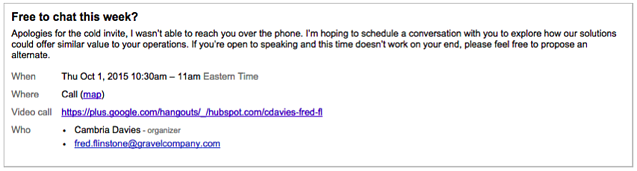
Jill Konrath also suggests scheduling a short 5-minute meeting to get our foot in the door with prospects whose calendars are particularly swamped.
The Prospecting Call
If we decide to call a prospect, whether in conjunction with an email or not, we can follow this basic structure for the call:
- Establish rapport: We shouldn’t shy away from personal conversations, like asking how a prospect’s weekend was or what team they’re rooting for in the game tonight. These intimate touches help us develop a more meaningful relationship with prospects and enhance our likeability which, hopefully, means a prospect will be more likely to buy from us.
- Leverage pain points: Dive into their pain points during the call. By the end of the conversation, we should know all of their primary business challenges and the underlying causes associated with them. Once we have an understanding of these key issues, we can better position our product or services to solve them.
- Create curiosity: Ask questions about their business. Ask more than telling. This conversation is about them and understanding their needs and problems. The less we talk about our business and product, the more our prospect will be interested to hear the final pitch.
- Wrap it up: Find a calendar time between 24-48 hours after the discovery call to book a follow-up meeting. Try this line: “Would you have 30 minutes to follow up this week? My colleague, John, will join us — he’s an expert in X, Y, Z. My calendar’s open, what works best for you?”
Step 5: Iterate
Keep notes throughout this process to assess what activities generated value for the prospecting process and which wasted time.
After each contact with a prospect, we should assess how well we think us:
- Uncovered challenges
- Helped create well-defined goals
- Confirmed availability of budget
- Understand decision-making process
- Determined consequences of inaction
- Identified potential results of success
This self-reflection will help us improve our calling techniques in the future
Bryan Kreuzberger, the founder of Breakthrough Email, sends a follow-up email if prospects respond with a rejection. The purpose of this email is simple: Learning. We can use this rejection as an opportunity to better understand how we can improve our sales techniques by sending this template:
Hi [prospect name],
Thanks for your email, I just closed your file. I have a quick question as a final follow-up. Why aren’t you interested? Was it something I did?
If there is any way I can improve, let me know. I’m always looking for input.
Thanks for your help,
[Name]

One of HubSpot's sales managers uses Gmail labels to visualize his prospects in the sales funnel.
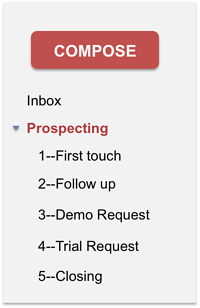
For example, after an initial discovery call, he sends a follow-up to his prospects and labels their response according to the action required of the account under the corresponding inbox. This allows him to easily shift gears when contacting cold prospects versus re-engaging old prospects or moving warm prospects further down the funnel.