
In today's competitive retail landscape, businesses constantly seek innovative strategies to boost sales and effectively reach their target audience. One key factor that can significantly impact sales is understanding the differences between traditional Retail and e-commerce. This comprehensive guide aims to give businesses a deep dive into each channel's needs, benefits, and challenges, empowering them to make informed decisions and maximize their sales potential.
Traditional Retail: A Brick-and-Mortar Approach
Traditional Retail refers to physical stores where customers can visit and purchase products. This approach has been a staple in the retail industry for centuries, offering a tangible experience and the ability to engage with customers in real-time. However, as the e-commerce landscape grows, traditional retailers must adapt to stay competitive.
Key Benefits of Traditional Retail:
- Tangible Experience: Customers can physically touch and inspect products before purchasing.
- Personalized Service: Retailers can provide personalized recommendations and assistance to customers.
- Convenience: Customers can visit stores conveniently without needing to shop online.
Challenges of Traditional Retail:
- Limited Product Range: Traditional retailers may have a limited selection of products compared to online retailers.
- Higher Costs: Operating physical stores can be more expensive, including rent, utilities, and staffing.
- Competition: Traditional retailers face competition from online retailers, which can be challenging to overcome.
E-commerce: A Digital Approach
E-commerce, or online Retail, refers to selling products and services online. This approach has gained popularity recently, offering convenience, accessibility, and a wider product range. However, e-commerce also presents challenges that businesses must overcome.
Key Benefits of E-commerce:
- Convenience: Customers can shop from anywhere with an internet connection any time of the day or night.
- Accessibility: E-commerce stores are open 24/7, providing customers with easy product access.
- Wider Product Range: E-commerce stores can offer a wider selection of products than traditional retailers.
Challenges of E-commerce:
- Competition: E-commerce faces competition from traditional retailers and online marketplaces, which can be challenging to overcome.
- Technical Issues: Technical problems, such as website crashes or slow loading times, can negatively impact the customer experience.
- Shipping and Delivery: Ensuring timely and reliable shipping and delivery can be challenging for e-commerce businesses.
Understanding the Differences Between Retail and E-commerce
Understanding the differences between Retail and e-commerce is crucial for businesses and consumers. By recognizing each channel's unique strengths and challenges, companies can develop effective strategies to leverage their full potential and maximize sales.
Understanding the differences between Retail and e-commerce allows businesses to allocate their resources and efforts effectively. Traditional retailers can focus on providing a tangible experience and personalized service, while e-commerce businesses can leverage the convenience and accessibility of online shopping to reach a wider audience.
Understanding the differences between Retail and e-commerce empowers consumers to make informed purchasing decisions. By considering the convenience, accessibility, and product range of each channel, consumers can choose the best option for their needs and preferences.
In conclusion, Retail and e-commerce are two distinct channels that offer unique benefits and challenges. By understanding the nuances between these channels, businesses and consumers can make informed decisions and maximize their sales potential in today's competitive marketplace.
For instance, a product like perfume requires a tactile experience, which strongly supports traditional Retail. However, e-commerce channels can facilitate repeat purchases of the same scent once a consumer has experienced the product in real time.
Consider buying a personal care item like shampoo, which has standardized manufacturing. It can be easily sold online only.
Depending on the product, sellers have the option to integrate both channels for specific categories or limit sales to one channel alone.
What is Retail?
Retail involves businesses making bulk purchases from wholesalers (sometimes manufacturers or distributors) and marking up the prices to generate profits for the end customer.
Types of Retail Models:
- Brick-and-mortar: This traditional model relies solely on physical stores to sell products or services. Customers can inspect products, interact with sales associates, and make immediate purchases. Payment options include cash or digital modes.
- Multi-Channel: This model combines physical stores and online channels but operates independently. For example, Apple utilizes its flagship store, website, and third-party marketplaces like Amazon to reach a wider audience. However, it's important to note that adding an iPhone to a cart from the website and purchasing it in an Apple store is impossible due to the lack of integration between these channels. Customers can only choose one channel per transaction.
- This strategy's main advantages include increased brand awareness, more sales channels, and revenue boosts. However, the challenges include inventory management and cost overhead.
Omni-Channel:
This approach provides a seamless shopping experience across multiple channels, ensuring a consistent brand experience. Notable examples of businesses using this model include Ajio, Zara, and PepperFry. They have implemented an integrated approach where customers can purchase online and pick up or return in-store, offering a unified experience across all channels.
BOPIS and BORIS are two key strategies brands employ to implement the Omni-channel retail model.
This approach's primary advantages are the acquisition of precise customer insights from online stores and the enhancement of brand loyalty. However, the high marketing costs and the intricate requirements of an advanced supply chain pose significant challenges.
Retail stores continue to play a crucial role in the consumer journey, providing various opportunities:
- Product Discovery and Experience: Customers often need to physically interact with products such as footwear, furniture, and home appliances to make informed decisions. For instance, when purchasing a sofa set, customers may sit in it to experience its comfort and sizing and even consult sales associates to understand its usage, make, and other details before making a purchase.
- Social and Emotional Connection: Stores foster community and brand loyalty among customers. Retail brands like Tanishq offer prepaid plans to encourage repeat purchases, while FirstCry offers tiered memberships with discounts and other benefits.
- Instant Gratification: The immediate purchase and possession of products provide consumers with instant gratification, which is often lacking in online shopping experiences.
- Emotional Appeal: Certain categories of shopping can be emotionally charged. For example, buying a cradle for first-time parents can evoke strong emotions, and online shopping may not fully replicate the offline experience for customers.
Despite these advantages, traditional retailers face numerous challenges, including rising operational costs, intense competition from e-commerce, and changing consumer preferences. Additionally, their growth is limited by relying solely on foot traffic and having limited warehousing capabilities.
However, e-commerce also offers opportunities to leverage technology, enhance customer experiences, and target niche markets. Since human interaction significantly impacts customer experiences, traditional Retail can easily outperform e-commerce in this regard.
E-commerce involves buying and selling physical and digital goods and services over the Internet through various platforms, such as online marketplaces, dedicated apps, online stores, and even social channels.
The e-commerce industry encompasses various business models, including:
- B2B (Business-to-Business): Business transactions are categorized as B2B e-commerce. For instance, AliExpress is a prominent B2B e-commerce model that enables businesses to purchase from other listed manufacturers globally and resell the products to end customers.
- B2C (Business-to-Consumer): Transactions between businesses and individual consumers are classified as B2C e-commerce. For example, the clothing brand SutiSancha directly sells its products to its target consumers without intermediaries.
- C2C (Consumer-to-Consumer): Transactions between individual consumers facilitated by online shopping are known as C2C e-commerce. This model allows consumers to sell pre-owned goods across various categories. Examples include platforms like Craigslist, OLX, and Quikr.
- C2B (Consumer-to-Business): This model involves individuals providing online services to businesses. For instance, influencers or freelancers offer their services to businesses.
E-commerce transactions are a series of activities that facilitate the delivery of products to buyers.
- Online marketing involves attracting and engaging customers with your brand. It starts with customers discovering your online store on a third-party marketplace or standalone website through search engines or social media. Then, you engage your target customers and build trust through email marketing or ads for sales to proceed.
- Online sales involve securely processing orders and payments through online platforms. The e-commerce business must integrate its physical inventory and reflect ongoing offers and stock levels in real time at the front end of order processing.
The front end is what customers see and interact with while shopping online. Additionally, the e-commerce business needs to integrate multiple online payment portals to receive digital payments.
India's daily online transactions amount to INR 10,000 crore, highlighting the need and popularity of online payments, the leading payment mode after Cash on Delivery.
This massive amount is distributed as follows: 30% of digital wallets, 25% of credit/debit cards, 40% of UPI transactions, and 5% of net banking.
- Once an order and payment have been processed, the next step is updating the products' inventory, packaging, and shipping. This involves sourcing inventory and packaging materials, packing and transporting products to customers, and managing returns, if any.
- CX - Customer experience is a crucial aspect of the transaction. It involves providing support and resolving customer queries. This includes confirming order status, verifying delivery status, and communicating with the end customer.
Key features of the e-commerce industry include online marketing, sales, order fulfillment, and customer service.
- E-commerce has revolutionized the business landscape by offering global reach, 24/7 accessibility, product variety, price comparison, and online reviews.
- Global Reach: The internet has no boundaries, enabling businesses to reach an international audience. They only need a profitable logistics partner to ensure smooth and fast delivery.
- 24/7 Accessibility: Online stores are open 24/7, providing convenience to consumers. No more commuting or waiting in queues for billing or considering store timings to make a purchase.
- Product Variety: E-commerce stores can offer a wide variety and assortment due to their lack of physical space constraints compared to traditional retail stores. Strategic warehousing and recent dropshipping developments have further expanded their product offerings.
- Price Comparison: Consumers can easily compare prices and find the best deals. Third-party marketplaces and dedicated apps provide features to sort products based on filters, allowing shoppers to compare multiple variants of the same product category before making an informed decision.
- Online Reviews: Online reviews and opinions are crucial in helping users determine if a product is worth buying. User-generated content, including images, videos, and written reviews, provides valuable insights into the usability and quality of products before a purchase.
Types of E-commerce Platforms
- Marketplaces: Platforms like Amazon and Flipkart host multiple sellers. Popular marketplaces, such as Myntra and Nykaa, initially focused on fashion but have since expanded to various categories. The significant advantage of these marketplaces is their established user base. However, this also means stiff competition from other sellers on the platform. Approximately 60% of online transactions occur through these marketplaces.
- Standalone Flagship Stores: Independent online stores owned by individual businesses also contribute to online sales. Brands with substantial market share and recall value drive more sales from their websites. These websites have advantages, allowing brands to establish direct customer relationships and avoiding platform fees. However, the main challenge of such websites is attracting an audience, especially for smaller and newer brands.
- Social Commerce: Selling products directly through social media platforms has gained popularity. Platforms like Facebook Marketplace, Instagram Shops, and TikTok Shops offer a more engaged audience because they are community-oriented. Moreover, the algorithms of these platforms effectively target potential buyers based on their browsing history.
E-commerce vs. E-Retail:
- Online Retail, or E-Retail, is a subset of E-commerce that focuses on selling retail products online directly to consumers through online stores. While they may occasionally have physical stores, they offer consumers more cohesive and immersive experiences. However, the expenses can add up.
- E-commerce generally encompasses a series of complex activities such as logistics and payments. It also includes selling services, digital products, online auctions, and the booking of e-tickets. E-commerce operates exclusively through B2C mode, selling directly to consumers.
- The core differences between e-commerce and online retailing can be summarized as follows:
Traditional Retail vs. E-Retail:
Traditional retailing has existed for a long time, with physical stores offering an in-store experience and immediate fulfillment to customers. However, these stores rely on outdated inventory and supply chain management methods.
On the other hand, E-retailing is a relatively new phenomenon that primarily focuses on online stores. It offers the advantage of a large dataset on consumer behavior, which is generally absent in traditional retail models. Additionally, unlike traditional retail, the supply chain and logistics of e-retailing can be automated.
Feature Traditional Retailing E-retailing
In-store vs. Online Shopping Experience Physical stores, in-person interactions Digital storefronts, virtual experiences
Payment and Fulfillment Cash, credit cards, or digital wallets
Immediate fulfillment Online payment gateways, digital walletsDelayed fulfillment
Inventory Management and Supply Chain Variations Physical inventory and warehouse management Digital inventory tracking, efficient logistics
| Feature |
Traditional Retailing |
E-retailing |
| In-store vs. Online Shopping Experience |
Physical stores, in-person interactions |
Digital storefronts, virtual experiences |
| Payment and Fulfillment |
Cash, credit cards, or digital wallets Immediate fulfillment |
Online payment gateways, digital walletsDelayed fulfillment |
| Inventory Management and Supply Chain Variations |
Physical inventory and warehouse management |
Digital inventory tracking, efficient logistics |
The growth of online shopping in India has been a significant transformation, as all e-commerce sellers can attest. The pandemic played a pivotal role in this transformation, expanding the reach and adoption of e-commerce.
As a result, Indian online shoppers come from diverse financial backgrounds and reside in major and tier 3 cities. Their search patterns and priorities regarding price, delivery times, and product quality vary widely.
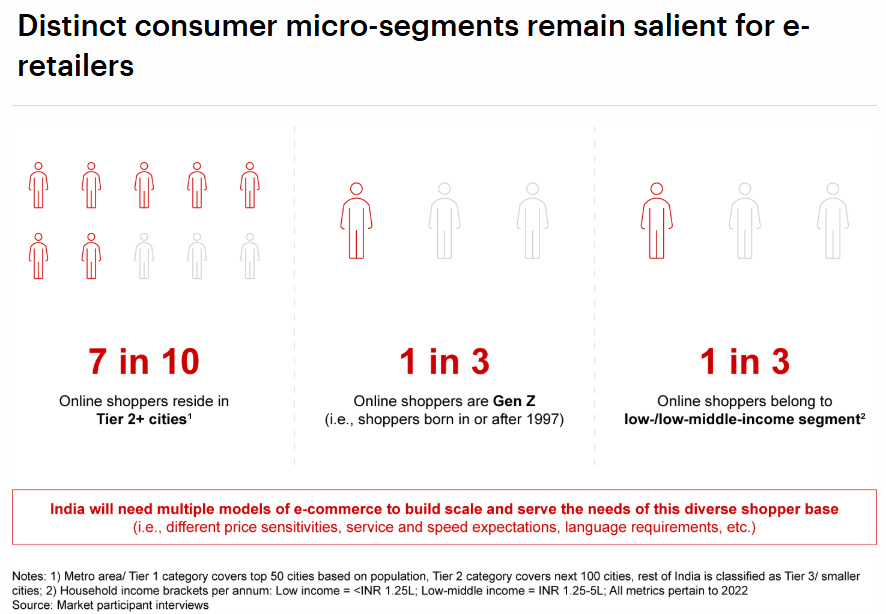
E-commerce has revolutionized shopping in India, offering millions of consumers convenience, choice, and affordability. For instance, shoppers in tier-2 cities and smaller towns place up to 60% of their online orders, seeking discounts. In contrast, urban shoppers prioritize speedy and convenient delivery options.
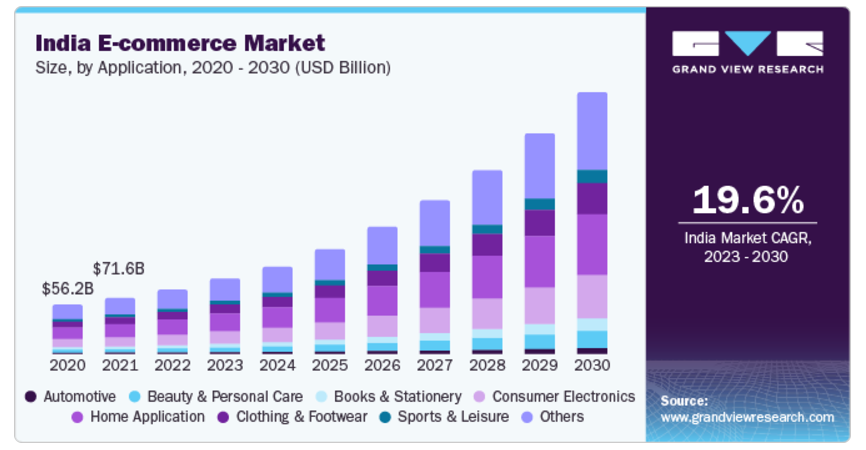
Key milestones in the growth of online shopping in India include the e-commerce market, which is projected to reach $230 billion by 2030, with an expected CAGR of around 19.6%.
Factors Driving the Rise of Online Retail Business in India
Three key pillars are driving the growth of online Retail in India:
1. Internet Penetration and Smartphone Adoption: Access to the Internet and mobile devices empowers consumers to shop online.- Every 8 in 10 Indian households has internet access, and India boasts the cheapest data packs globally.
- 850 million Indians own mobile phones.
- 9 out of 10 people without a phone live with someone who does, indicating the widespread adoption of affordable connectivity and devices.
A report predicts that digital payments, currently valued at INR 265 trillion, will triple and reach INR 593 trillion by 2028-29, with a projected volume of 159 billion transactions.
3. Consumer Demand for Convenience and Variety: As discussed earlier, Indian e-commerce buyers have diverse needs, including product choice, category, and price point.
Products from international brands and niche offerings are also in high demand in remote parts of India. E-commerce can fill this gap by leveraging advanced supply chain management and expanding beyond traditional warehouse capabilities.
The convenience of easy returns and doorstep delivery are significant drivers of e-commerce growth.
Types of Retail and E-commerce Companies
- Traditional Retail Giants and Their E-commerce Expansion: Established retailers like Reliance Retail and Aditya Birla Fashion have expanded their online presence. This move allows them to eliminate intermediaries in traditional Retail while still serving customers through a direct-to-consumer (D2C) model. By doing so, they have expanded their customer base and adapted to the digital age.
- Pure-play E-commerce Companies: Flipkart and Amazon India focus solely on online sales. These companies have mastered the online market through innovative supply chain management and data-driven insights into consumer behavior.
- Multi-channel Retailers: These retailers operate physical stores and online channels, providing a seamless shopping experience. Notable examples include Nykaa and Sugar Cosmetics. These brands combine the best of both worlds by ensuring an immersive shopping experience in retail outlets and offering convenience and variety in online stores.
Notable E-commerce Companies in India
- Leading E-commerce Platforms and Their Offerings: Amazon India, Flipkart, Myntra, and others offer a wide range of products and services. These platforms have become the go-to options for groceries, apparel, electronics, home decor, and more. These platforms retain customers through a strategic ecosystem of verified sellers, tiered memberships, site-wide sales, and super-fast delivery nationwide.
- Top Retail and E-commerce Companies by Sector: While e-commerce giants like Amazon or Flipkart offer various products across categories, certain companies specialize in specific areas. For instance, Pepperfry focuses on furniture, LimeRoad on apparel, Neeman's on shoes, and Licious on meat and seafood.
Impact of International E-commerce Companies in India
International e-commerce giants like Amazon and AliExpress have made significant inroads into the Indian market, offering global products and services to Indian consumers.
Benefits and Challenges of Retail and E-commerce:
Benefits of Ecommerce for Businesses and Consumers in India:
- Greater Market Reach and Convenience: E-commerce allows businesses to reach a global audience and provides consumers with 24/7 access to products. This contrasts with traditional retail stores, which rely on local consumers and have limited service hours. With e-commerce, people can order from anywhere and anytime, boosting revenue growth.
- E-commerce platforms can collect and analyze customer data for personalized recommendations and targeted marketing. This is achieved through online browsing across apps and stores, which generates valuable data sets. Modern AI and data analysis software can analyze this data to understand trends such as repeat purchases, product bundles, popular products across a location or age group, and more. This vital understanding helps e-commerce businesses stay ahead and plan their inventory better.
- For the reasons mentioned above, e-commerce businesses also have an edge in managing inventory levels and reducing operational costs. Additionally, the latest innovations in logistics and the digitization of the supply chain further enhance the smooth logistics of e-commerce stock.
- The comfort and affordable prices offered by e-commerce drive higher consumption demand, contributing to the economy's overall growth. On average, online vendors employ nine employees, compared to 6 by offline vendors. Moreover, around 15 million people employed in the e-commerce sector contribute to the national growth. Furthermore, the rise in e-commerce has led to a boost in female employment compared to the traditional retail industry.
- Another significant advantage of e-commerce is its potential for automation and scale. Technological solutions related to supply chain, logistics, packaging, and online presence enable e-commerce to operate without relying solely on individual employees. This scalability is easier to achieve than traditional Retail, which heavily depends on real estate investments and local staff.
- Physical stores offer enhanced consumer experiences and brand loyalty. They provide opportunities for personalized interactions and brand experiences that are difficult to replicate online. For example, Lego stores offer theme-based kits for different age groups, from famous monuments to popular sci-fi characters.
- Customers can also physically inspect products and get immediate assistance from store staff. Imagine buying a home theater system. You'll likely experience it in person rather than relying solely on images or videos to assess sound quality.
- Another advantage of physical stores is the ability to provide a tailored experience based on individual customer needs in real-time.
However, both retail and e-commerce companies face common challenges.
- Logistics and supply chain challenges are significant in e-commerce. Smooth and speedy delivery is crucial for customer experience, and any issues can impact the business.
- Another challenge is intense competition. The low barrier to entry in e-commerce promotes fierce competition to capture the customer base.
- Many smaller online stores also face data security concerns. They may lack the necessary resources and knowledge to comply with legal standards and manage data ethically.
- High operational costs are a major challenge in retail. Rent and utility costs consume a significant portion of profits, and buying a store upfront is a substantial real estate investment. Additionally, the presence of middlemen in the supply chain further reduces profit margins.
- Traditional retail stores also face limited store locations. Their expansion is limited by available funds and market conditions in their service area. Their success depends on foot traffic, and their customer base is confined to their vicinity.
- Digital transformation is crucial for these stores to automate and enhance efficiency by monitoring and managing daily operations like accounting and inventory management. This is because improvement can only be achieved through measurement.
- Another challenge is the high dependency on unskilled labor, which is prevalent in this unorganized sector and primarily employs low-skilled or unskilled local workers. While not a significant bottleneck, skilled and trained labor can play a vital role in implementing new ideas and concepts to boost business.
Several trends are shaping the retail and e-commerce landscape in India.
Key trends driving the e-commerce sector in 2025 include the rise of mobile commerce and social media integration.
- Mobile shopping and social commerce are becoming increasingly popular, with buyers utilizing mobile-based apps for browsing, purchasing, and making payments. For instance, customers can conveniently get groceries delivered through the Blinkit app.
- B2B (Business-to-Business): Business transactions are categorized as B2B e-commerce. For instance, AliExpress is a prominent B2B e-commerce model that enables businesses to purchase from other listed manufacturers globally and resell the products to end customers.
- D2C/B2C (Business-to-Consumer): Transactions between businesses and individual consumers are classified as B2C e-commerce. For example, the clothing brand SutiSancha directly sells its products to its target consumers without intermediaries.
- C2C (Consumer-to-Consumer): Transactions between individual consumers facilitated by online shopping are known as C2C e-commerce. This model allows consumers to sell pre-owned goods across various categories. Examples include platforms like Craigslist, OLX, and Quikr.
- C2B (Consumer-to-Business): This model involves individuals providing online services to businesses. For instance, influencers or freelancers offer their services to businesses.
E-commerce transactions are a series of activities that facilitate the delivery of products to buyers.
- Online marketing involves attracting and engaging customers with your brand. It starts with customers discovering your online store on a third-party marketplace or standalone website through search engines or social media. Then, you engage your target customers and build trust through email marketing or ads for sales to proceed.
- Online sales involve securely processing orders and payments through online platforms. The e-commerce business must integrate its physical inventory and reflect ongoing offers and stock levels in real time at the front end of order processing.
The front end is what customers see and interact with while shopping online. Additionally, the e-commerce business needs to integrate multiple online payment portals to receive digital payments.
India's daily online transactions amount to INR 10,000 crore, highlighting the need and popularity of online payments, the leading payment mode after Cash on Delivery.
This massive amount is distributed as follows: 30% of digital wallets, 25% of credit/debit cards, 40% of UPI transactions, and 5% of net banking.
- Once an order and payment have been processed, the next step is updating the products' inventory, packaging, and shipping. This involves sourcing inventory and packaging materials, packing and transporting products to customers, and managing returns, if any.
How E-commerce Has Revolutionized Shopping in India
E-commerce has transformed the way Indians shop, offering convenience, choice, and affordability to millions of consumers. For instance, shoppers in tier-2 cities and smaller towns place up to 60% of online orders. These shoppers look for discounts. Meanwhile, urban shoppers look for speedy and convenient delivery options.
Benefits and Challenges of Retail and E-commerce
Benefits of Ecommerce for Businesses and Consumers in India:
- Greater Market Reach and Convenience: E-commerce allows businesses to reach a global audience and provides consumers with 24/7 access to products. This is in contrast to traditional retail stores, which depend on the local consumer base and generally have limited service hours. With e-commerce, people can order from anywhere and anytime, boosting revenue growth.
- Personalization and Data-Driven Insights: E-commerce platforms can collect and analyze customer data to offer personalized recommendations and targeted marketing. Online browsing across apps and stores produces valuable data sets. Modern AI and data analysis software can analyze this data to understand trends like repeat purchases, product bundles, popular products across a location or age group, etc. Such vital understanding helps e-commerce businesses stay ahead and plan their inventory better.
- Efficient Inventory and Resource Management: For the similar reasons stated above, e-commerce businesses have an edge in managing inventory levels and reducing operational costs. Plus, the latest innovations in logistics and digitization of the supply chain only add to the smooth logistics of e-commerce stock.
- Contribution to society: Comfort and affordable prices help drive higher consumption demand, boosting the economy. On average, an online vendor employs 9 employees, against 6 by offline vendors. More so, around 15 million people employed in the e-commerce sector contribute to national growth. Another benefit of the rise in e-commerce is a boost in female employment compared to the traditional retail sector.
- Possibility of automation: One huge advantage of e-commerce is the potential for automation and scale. Thanks to technological solutions relating to supply chain, logistics, packaging, online presence, etc., e-commerce doesn't depend on any individual(s) alone. It is fairly easier to scale compared to traditional Retail, which heavily depends on real estate investments and local staff.
Advantages of Retail Traditional Markets
- Enhanced Consumer Experience and Brand Loyalty: Physical stores offer opportunities for personalized interactions and brand experiences. Person-to-person interactions will continue to impact buying decisions, helping traditional Retail to grow. For instance, Lego stores offer theme-based kits, from famous monuments to popular sci-fi characters for different ages. Such experiences are hard to replicate online.
- Immediate Product Availability and Hands-on Assistance: Customers can physically inspect products and get immediate assistance from store staff. Imagine you are buying a home theatre system. You will likely experience it in person rather than rely only on images or videos to assess sound quality.
- Real-time Support: Another advantage of physical stores is the ability to tailor an experience for individual customers based on their needs in real-time.
Common Challenges Faced by Retail and E-commerce Companies
In E-commerce:
- Logistics and supply chain challenges: E-commerce's success heavily relies on how a business handles logistics. Smooth and speedy delivery is a massive part of customer experience, making or breaking the company.
- Intense competition: The low barrier to entry, though, is beneficial on the one hand and promotes intense competition to capture the customer base.
- Data security concerns: Many smaller online stores don't have the necessary resources and knowledge on legal compliance and ethical data management.
In Retail:
- High operational costs: Rent and utility costs eat up a lot of physical store profits. Buying a store upfront is a huge real estate investment. Plus, many middlemen in the supply chain also lower the profit margins.
- Limited store locations: Traditional retail stores can only expand so much, depending on available funds and market conditions in their service area. Their success depends on foot traffic, and the consumer base is limited to their vicinity alone.
- Need for digital transformation: These stores can automate and be more efficient if they monitor and manage their daily operations, such as accounting, inventory management, etc., because you can only improve upon what is measured.
- High dependency on unskilled labor: This sector is unorganized and employs mostly low-skilled or unskilled local labor. Though not a major bottleneck, skilled and trained labor can help implement new ideas and concepts to boost business.
Trends Shaping Retail and E-commerce in India
Key Trends Driving the E-commerce Sector in 2025
- Rise of Mobile Commerce and Social Media Integration: Mobile shopping and social commerce are becoming increasingly popular. Buyers use mobile-based apps for browsing, purchasing, and even making payments. For instance, customers can get groceries delivered using the Blinkit app.
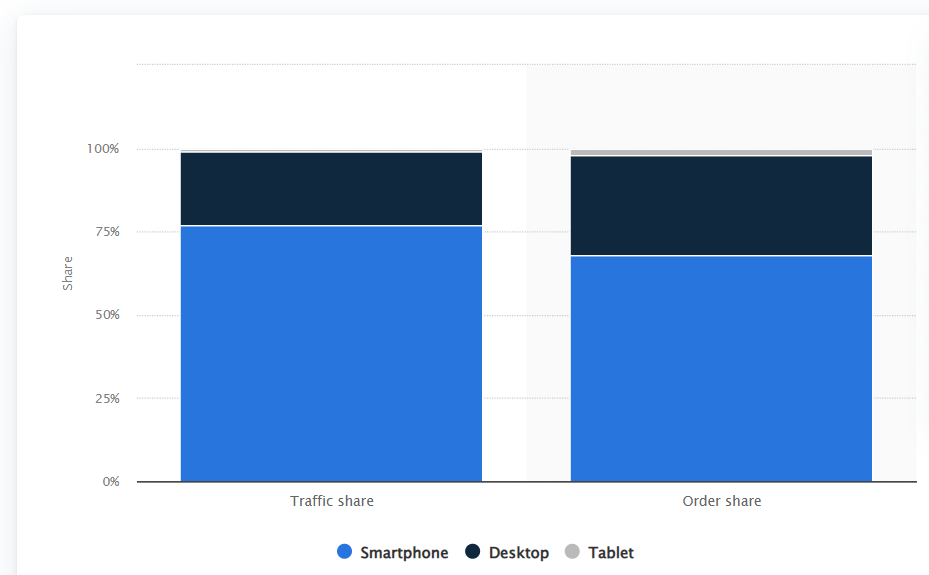
Image Credit – Statista
Also, Instagram and Facebook shopping have been on the rise since Covid. Online stores often livestream their products so that customers can buy them instantly. Social media ads and influencer-driven campaigns add to the sales volume as well.
- Growth of Subscription Models and Customization: Subscription-based models encourage consumers to repeat purchases, boosting brand loyalty. A mobile-commerce app, MilkBasket, offers a subscription for buyers to get their groceries and daily needs delivered within 24 hours for free.
- Online stores have access to a large amount of data, enabling them to make personalized recommendations. E-commerce businesses can use sophisticated recommender engines that study the past behavior of similar buyers and predict the products that shoppers are likely to buy. This helps in product discovery, personalized user experience, and revenue gain.
- AI and Automation in E-commerce Operations: AI tools improve operations and customer experiences. Flippi, the AI shopping agent from Flipkart, and Maya from Myntra are good examples of AI usage in e-commerce.
These tools function as an online salesman to help you discover the right products for your needs.
Automation can genuinely transform the health of an e-commerce business. From auto-updating the inventory in the back-end and front-end to updating customers about delivery status, automation has simplified the daily hassles of store owners while enhancing the user experience manifold.
Emerging Retail Trends in 2025
Immersive technologies are enhancing product visualization and customer engagement.
- Blurring of Lines Between In-store and Online Shopping: Retailers integrate online and offline channels to create seamless shopping experiences. As already discussed, omnichannel shopping is on the rise. E-commerce offers easier ways to enter new markets and capture market share. For the latest generation, shopping means the freedom to shop from anywhere, online or offline.
- Virtual and Augmented Reality in Retail Experiences: AR enhances the real-world environment by overlapping digital elements, offering a partially immersive experience.
- For example, jewelry brands like Giva and Kalyan help customers select jewelry pieces with virtual try-on features in their specialized apps.

- Lenskart launched a similar feature, allowing users to try their frames virtually using their native app and select the best product.
- H&M group (Sweden) helps customers create a virtual avatar using 3-D body scanners. Shoppers can then receive personalized recommendations of fit, color, and styles. Then, customers can place customized orders for jeans that are tailor-made for them.
- Conversely, VR is experiencing the virtual world as if it were the real world.
- Brands like Ikea have offered a virtual showroom or 'Virtual Home Experience' to help customers experience interior and home decor options. Buyers wear VR headsets, and now they can inspect products in real life, giving a 360 ° visualization of all possibilities.
Sustainable and Ethical Consumer Preferences:
Retail trends in India are driven by an educated youth with significant purchasing power. They now prefer brands that follow sustainable and ethical manufacturing processes, are vocal about concerns, and go beyond just showing off their brand values.
It's safe to conclude that consumers are increasingly prioritizing sustainability and ethical practices. In the example above, garments manufactured post-personalization won't add up to retail garbage and turn out to be climate-positive.
The circular economy has opened new doors for reused and rental products to appear in the market.
Mindful shopping is another trend where shoppers want to buy high-quality products, even if that means paying a higher price. The focus is on quality instead of quantity.
How Retail and E-commerce Are Adapting to Consumer Behavior Changes
Retailers and e-commerce businesses are adapting to changing consumer behavior by:
- Leveraging Data Analytics: With the rise of first-party and third-party data for individual shoppers, it is very easy for brands to collect and analyze data points to detect patterns about segments of buyers. This can help find current shopping trends and seasonal influences to better manage inventory. Analyzing data can also help determine an optimal pricing and discounting strategy that works in real time.
- Personalizing the Shopping Experience: Brands can stand out by tailoring product recommendations and marketing messages to individual preferences. Data analytics can trace individual user purchase history to offer personalized product recommendations and promotions that are most likely to push customers to buy.
- Investing in Technology: Brands today must adopt innovative technologies to improve supply chain efficiency and customer experience; otherwise, they will be left behind. Imagine using technology to automate customer chat support and engagement for millions of customers with AI's help, as Shoppers Stop recently did.
Future of Retail and E-commerce in India
Opportunities for Growth in Retail and E-commerce
- Expanding to Tier 2 and Tier 3 Cities: There's a massive opportunity for e-commerce brands to grow in the untapped markets in smaller cities and towns. These buyers are looking for variety and reasonable prices, both of which can be offered by online brands.
- Increasing Role of Digital Payment Solutions: Economical mobile devices have boosted digital payments. The ease of use and availability of multiple payment channels, such as UPI, QR codes, native bank apps, etc., have also helped the widespread use of digital payments.
- Government Initiatives Supporting E-commerce Growth: E-commerce sellers must leverage government support and policies to boost the E-commerce sector. The government is focused on improving tax structures, increasing exports, and empowering the online retail industry.
Challenges Ahead in the Retail and E-commerce Landscape
- Addressing Competition and Market Saturation: As much as large players boost industry growth, they capture significant market share and make it difficult for smaller businesses to sustain. It also reduces the profitability of small businesses operating on smaller margins to attract customers.
- SMB & Cottage industry need to listen to their target audience and commit to solving their real problems to stand a chance against huge sellers with large budgets. Offering discounts or free delivery can't help them stand out in the long run.
- Overcoming Supply Chain and Logistics Hurdles: Ensuring efficient and timely delivery of products remains a significant challenge. Large players have stronger delivery infrastructure, giving them an edge regarding same-day or next-day delivery. Small businesses must use shipping platforms to offer to their customers.
The Long-term Outlook for Retail and E-commerce
The future of Retail and e-commerce in India is promising. As technology advances, we can expect further innovation and disruption in the industry. A hybrid approach, combining the best of both worlds, will likely be the key to success.
Conclusion
Recap of Key Differences Between Retail and E-commerce
- Retail: Physical stores offering in-person interactions and immediate gratification will remain relevant shortly. However, they will face intense competition from online stores unless they adopt upcoming trends and provide excellent customer experience.
- E-commerce: Online stores that offer digital interactions combined with convenient and speedy delivery will continue to gain more momentum. Online businesses that offer a large assortment of products and fast delivery will likely thrive.
How Retail and E-commerce Complement Each Other in the Modern Market
Both Retail and e-commerce have advantages. They can complement each other to create a seamless shopping experience for customers. For instance, retailers can use online channels to expand their reach and provide additional services. At the same time, e-commerce businesses can establish physical stores to enhance brand experience and offer offline support.
Final Thoughts on the Evolving Landscape of Retail and E-commerce in India
The Indian retail and e-commerce landscape is dynamic and ever-evolving. By understanding the key differences, challenges, and opportunities, businesses can navigate this complex environment and emerge as leaders in the industry.
Key Takeaways on Retail and E-commerce-
- Retail and e-commerce are excellent channels for increasing sales for any Indian business.
The e-commerce way is more favorable for upcoming brands that need to grow fast.
- Traditional Retail works well for more established businesses that can offer immersive experiences for customers.
- With a bigger budget, you can use both channels to make the best of both worlds.