
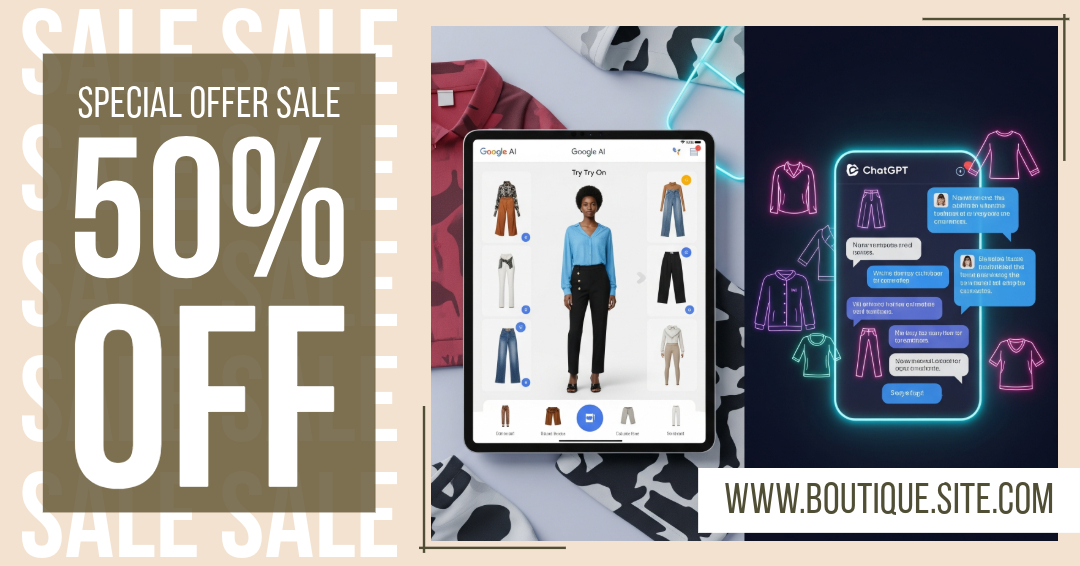
The age of AI is rapidly transforming how we interact with technology, and our wardrobes are the latest frontier. Google recently unveiled a significant "AI Mode" update to its shopping experience, packed with features designed to help you virtually try on clothes and get fashion guidance. This move puts it squarely in competition with the increasingly versatile ChatGPT, which many users are already turning to for style advice.
As a technologist, the underlying AI is fascinating. But as users, what truly matters is the experience: how intuitive is it, how well does the AI understand our unique style, and critically, how quickly can it learn and adapt to our preferences with just a few interactions? Let's dive into a detailed comparison.
Google's AI-Powered Shopping Experience: Visual, Integrated, and Transactional
Google's latest shopping features, announced around its I/O 2025 event, aim to create a more immersive and personalized online shopping journey, particularly for apparel.
Key Features:
- Virtual Try-On with Your Own Photo: This is the headliner. Users can now upload a full-length photo of themselves to see how billions of apparel items (shirts, pants, skirts, dresses initially) might look on their specific body type. Google states this uses a "custom image generation model for fashion" designed to realistically render how different fabrics fold, stretch, and drape.
- What you'd see (Hypothetical Screenshot Description): Imagine a split screen. On one side, the product image on a model. On the other, your uploaded photo with the garment realistically superimposed onto your image. You'd likely see options to save the look or share it.
- AI Mode for Shopping: This feature leverages Google's Gemini AI model and its massive Shopping Graph (over 50 billion listings). It allows for more conversational and contextual searches. For example, searching "cute travel bag for a rainy trip to Portland in May" would prompt AI Mode to consider weather-appropriate materials and styles, presenting curated visual options.
- Agentic Checkout: Once you've found an item, Google is rolling out a feature where you can track the price, set your desired price, size, and color, and Google can notify you or even "buy for me" by adding it to the retailer's cart and completing the transaction using Google Pay.
- Personalized Browse and Filtering: AI Mode aims to tailor results to your preferences, which it learns from your search history and interactions.
The Tech Under the Hood (For the Technologist):
Google's approach combines several powerful AI components:
- Generative AI for Virtual Try-On: This is a sophisticated image generation model specifically trained for fashion. It needs to understand human anatomy, garment physics (draping, stretching, folding of various materials), and how to realistically superimpose clothing onto a user's photo, maintaining perspective and detail.
- Large Language Models (LLMs) & Semantic Search (Gemini): Powering the "AI Mode," these models help Google understand nuanced, conversational queries beyond simple keywords. The "query fan-out" process mentioned in some reports suggests the AI breaks down complex requests into multiple sub-searches to gather relevant information (e.g., weather in Portland in May + types of travel bags + stylish options).
- Shopping Graph: This is a colossal, continuously updated database of products, retailers, reviews, prices, and availability. The AI leverages this graph to provide relevant, in-stock product suggestions. Google claims it's refreshed every hour with over 2 billion updates.
User Experience & AI Adaptability:
- UX Focus: Google is aiming for a visually rich, intuitive, and seamless experience that directly addresses the pain point of online clothes shopping: "Will this fit me and look good?" The virtual try-on is a significant step towards this. The integration with the vast product catalog and potential for agentic checkout streamlines the path from discovery to purchase.
- Learning & Adaptation: Google's AI learns from your search queries, the products you click on, and potentially other Google service interactions (if opted in, for things like travel plans from Gmail influencing recommendations). The more you use it, the better it should get at understanding your style, preferred brands, and price points. The "AI Mode" is explicitly designed to adapt to more complex and contextual user needs in just a few interactions by understanding intent rather than just keywords.
Potential Links:
- Keep an eye on the official Google Blog and Google Search Labs for announcements and access to these features (availability, especially the personal photo try-on, is initially rolling out in the US).
ChatGPT as Your Fashion Advisor: Conversational, Creative, and Evolving
While not a dedicated shopping platform from the outset, ChatGPT's powerful conversational abilities have made it a surprisingly adept fashion advisor for many. OpenAI is also making moves to make ChatGPT more shopper-friendly.
Key Features:
- Conversational Styling Advice: Ask ChatGPT anything from "What should I wear to a summer wedding?" to "How can I style a denim jacket for a smart-casual look?" or "Help me build a capsule wardrobe for work." It can generate ideas, explain fashion concepts, and even help you define your personal style through dialogue.
- Personalized Recommendations (Text-Based): Based on your prompts (describing your preferences, body type, existing wardrobe items, budget, occasion), ChatGPT can suggest specific types of clothing, color palettes, and outfit combinations.
- Image Analysis (with GPT-4V): Users with access to GPT-4 with Vision can upload images of clothes they own or like, and ask for styling advice based on those visuals.
- Emerging Shopping Integrations/Plugins: OpenAI has been enhancing ChatGPT's ability to browse the web and integrate information, leading to more direct product suggestions with details like images, reviews, and sometimes links to purchase, aiming for ad-free, unbiased results. Some third-party services (like YesPlz.ai's "ChatGPT Fashion Stylist") also leverage ChatGPT for fashion-specific applications.
The Tech Under the Hood (For the Technologist):
- Large Language Models (LLMs): ChatGPT (variants of GPT-3.5 and GPT-4) is built on sophisticated LLMs. Their strength lies in understanding and generating human-like text, engaging in coherent conversations, and synthesizing information from vast training data.
- Natural Language Processing (NLP): This allows ChatGPT to interpret complex user requests, understand nuances in language (like style preferences, occasion formality), and respond appropriately.
- Vision Capabilities (GPT-4V): The ability to process and understand images opens up new avenues for visual fashion advice.
- Web Browse & Plugins: These extend ChatGPT's knowledge beyond its initial training data and allow for more current product information and links, though the product dataset isn't as directly integrated or curated as Google's Shopping Graph.
User Experience & AI Adaptability:
- UX Focus: The experience is primarily conversational and text-driven (though visual input is possible with GPT-4V). It's like brainstorming with a knowledgeable stylist who can offer a wide range of ideas and explanations. The strength is in the dialogue and the ability to refine requests iteratively.
- Learning & Adaptation: ChatGPT learns within the context of a single conversation. You can guide it, correct it, and provide more details, and it will adapt its responses accordingly. For more persistent learning about your style across sessions, users often develop specific prompting strategies or use custom instructions if available. The ability to "remember" preferences from a few interactions within a session is quite strong. Platforms built on ChatGPT (like dedicated fashion stylist tools) might offer more persistent user profiles.
Potential Links:
- Explore OpenAI's official website for information on ChatGPT's latest capabilities and access. Look for updates on Browse features and potential e-commerce integrations.
Head-to-Head: The Technologist's View
| Feature | Google's AI Shopping | ChatGPT for Fashion Advice |
| Core AI | Generative Image Models, LLMs (Gemini), Knowledge Graph (Shopping Graph) | LLMs (GPT-3.5/4), NLP, Vision (GPT-4V potentially) |
| Data Source | Massive, real-time Shopping Graph (billions of listings) | Training data, live web Browse (for newer info/products) |
| Visuals | Core to the experience (virtual try-on, image-rich results) | Primarily text-based, visual input with GPT-4V, emerging image display for products |
| Integration | Deeply integrated with product search and e-commerce ecosystem | More reliant on web Browse for product specifics; plugin ecosystem growing |
| Personalization | Driven by search history, Shopping Graph interactions, contextual signals (e.g., location, weather) | Driven by conversational context, user prompts, custom instructions |
Key Technical Differentiator: Google's direct control over a vast, structured product database (Shopping Graph) and its investment in specialized generative AI for fashion visuals give it a distinct advantage in providing actionable, product-specific recommendations and a true virtual try-on experience. ChatGPT's strength is its flexible, powerful language understanding and generation, making it excellent for broader style consultation and creative ideation.
Head-to-Head: The User's View
| Aspect | Google's AI Shopping | ChatGPT for Fashion Advice |
| Getting Dressed For... | Specific items you're considering, discovering new products to buy, visualizing fit. | Brainstorming ideas, defining style, getting advice on existing wardrobe, understanding trends. |
| Ease of Use | Increasingly visual and intuitive, especially with try-on. Search can be conversational. | Natural language conversation; requires good prompting for best results. |
| Personalization Feel | Can feel very personalized quickly due to visual try-on and context-aware search (e.g., "for my trip"). | Highly personalized within a conversation as you provide more details. |
| Learning Curve | Low for basic search and try-on. Understanding "AI Mode" nuances might take a bit. | Learning to write effective prompts is key to unlocking its full potential. |
| "Aha!" Moment | "Wow, I can see how that actually looks on me!" or "It found exactly what I needed for this specific scenario!" | "That's a brilliant idea I hadn't thought of!" or "It perfectly understands the vibe I'm going for." |
| Adaptability (Few Interactions) | Google's AI Mode aims to quickly narrow down choices based on contextual refinements in your search. The visual try-on instantly adapts the product to your photo. | ChatGPT excels at adapting its suggestions within a single conversation as you provide iterative feedback and clarification. |
| End Goal | Facilitate confident purchase decisions. | Provide inspiration, advice, and understanding. |
Which AI Stylist is Right for You?
-
Choose Google's AI Shopping if:
- You want to virtually try on clothes on your own photo before buying.
- You have a specific item or occasion in mind and want to see concrete, purchasable options.
- You appreciate a visually-driven shopping experience integrated with a vast product catalog.
- You want help finding the best price or even automating parts of the checkout.
-
Choose ChatGPT if:
- You're looking for broader fashion advice, style inspiration, or help defining your look.
- You want to "talk through" your fashion dilemmas with an AI.
- You want ideas on how to style pieces you already own.
- You enjoy a more creative and conversational approach to fashion.
The Future is Likely Hybrid
Both Google and OpenAI are pushing the boundaries of AI in commerce and personalization. It's not necessarily an either/or situation. You might use ChatGPT to brainstorm ideas for a new look and then use Google's AI Shopping tools to find and virtually try on specific items that fit that vision.
The ability of these AI models to learn and adapt from just a few interactions is a game-changer. Google's contextual awareness in "AI Mode" and the immediate feedback of the virtual try-on show rapid adaptation. ChatGPT's conversational flow allows it to quickly pivot and refine suggestions based on a user's evolving input.
Ultimately, the "edge" depends on the specific task at hand. For the practicalities of online clothes shopping and reducing the risk of a bad fit, Google's new visual tools currently offer a more direct and impactful solution. For broader style counsel and creative exploration, ChatGPT's conversational prowess remains a powerful asset.
The real winner? The user, who now has increasingly sophisticated AI assistants ready to help them look and feel their best. It will be exciting to see how these platforms continue to evolve and perhaps even learn from each other.